Iran Conflict – What is driving markets?
Uncertainty has unsettled markets As we pass one week since…

As we pass one week since the start of the US-led attack on Iran, markets have adopted a more risk-off attitude as the conflict in the Middle East widens and energy prices spiked. Equities have come under pressure, government bond markets have been unsettled and commodity markets have moved sharply as investors reprice the risk of a renewed inflation shock.
The conflict has broadened to include US allies in the region, such as Saudi Arabia, Kuwait and the UAE, but markets are reacting less to the conflict itself, and more to the possibility that it disrupts global energy supply and delays the path back to lower inflation and easier monetary policy.
The most significant development is Iran’s co-ordinated attacks on oil and gas production, storage and shipping throughout the Arabian Gulf. This included the effective closure of the Strait of Hormuz. With the only shipping route out of the Arabian Gulf blocked, a shortage of storage means Iraqi oil production has fallen sharply, and Qatar’s LNG output has also been disrupted.
Meanwhile, Iran has appointed Mojtaba Khamenei as supreme leader following the killing of Ayatollah Ali Khamenei. The new leader is Ali Khamenei’s son and markets have read his selection as a sign that hardline leadership remains in place and a quick de-escalation of the conflict is less likely.
The Strait of Hormuz is the only route for seaborne oil and gas shipments from the Arabian Gulf
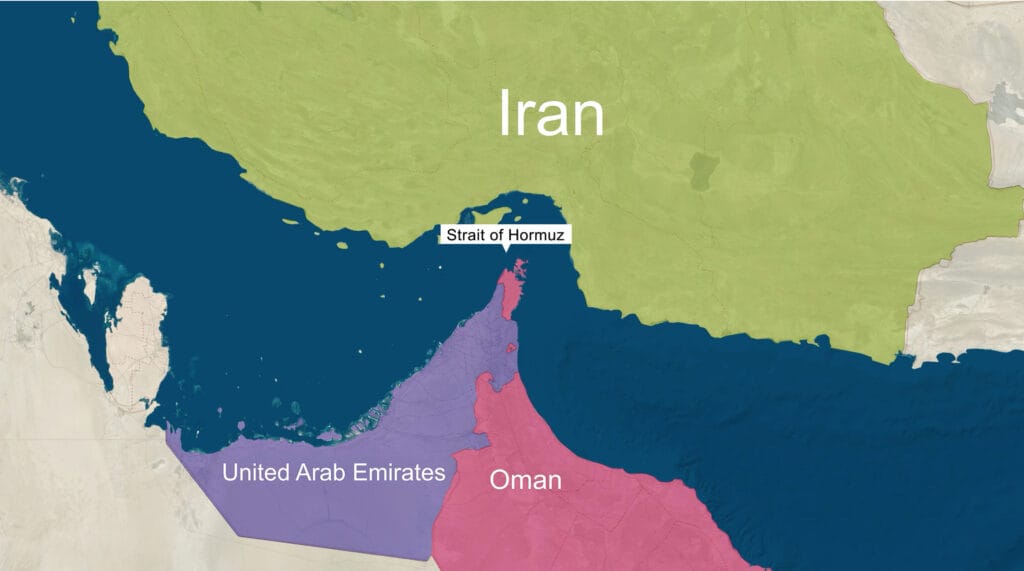
Illustration 1 – image file sent separately. Source: Adobe Stock, March 2026
That backdrop has hit energy markets hardest. Brent crude surged to around $119 a barrel on Monday, marking its highest level since 2022. The price of oil has risen almost 30% since the end of February, reflecting fears that a prolonged interruption in Gulf exports could leave the market materially short of supply. European gas prices have also spiked. The Dutch gas price benchmark is up 92% since the start of the conflict and the UK spot gas price is up 103%. These are big gains in a very short period but, for now, are far short of the levels hit after Russia’s invasion of Ukraine.
Governments and the G7 are discussing potential emergency responses, including the possible release of strategic oil reserves.
Where prices go from here is down to how long the conflict drags on for and this depends on many factors including the level of domestic support for the military action in the US, as well as how countries in the Middle East respond.
Equity markets have responded in the way one would expect when energy prices rise this quickly. European equities recorded their biggest weekly fall in close to a year, and Asian markets also sold off sharply as investors absorbed the implications for growth and inflation. In the UK, the FTSE 100 fell heavily at the start of Monday trading as the oil spike fed through into broader market sentiment. The weakness has been evident in most industry sectors, but the pressure is especially acute in areas of the market that are more sensitive to consumer spending, transport costs and the interest-rate outlook.
Chart 1 – Uncertainty has caused equity and bond markets to fall since the start of the US-led attack on Iran

Source: FE Analytics, total returns in GBP. 06/03/2025 to 06/03/2026
One of the features of the past week is that government bonds have not provided the clean defensive offset that investors often expect during geopolitical shocks. Instead, yields have generally risen, as bond values fell, because markets are focusing on the inflationary consequences of higher oil and gas prices. US 2-year treasury yields posted their biggest weekly rise since last year’s tariff volatility. UK gilts have seen an even steeper decline, as the yield on 10-year gilts have increased from 4.23% to 4.71% since 1 March, as investors who had been expecting interest rate cuts now see the potential for rate hikes from the Bank of England.
For inflation, the transmission mechanism is straightforward. Higher oil prices raise fuel and transport costs directly. Higher gas prices matter for electricity generation, heating and industrial input costs, particularly in Europe. They can also feed into food prices through fertiliser, logistics and broader supply-chain costs. The practical implication is that central banks may become more cautious about cutting rates, even if headline growth softens.
Gold’s behaviour has been more nuanced than usual. It initially benefited from safe-haven demand, but it has fallen back as the US dollar strengthened and bond yields rose. That is a useful reminder that gold does not respond only to geopolitical stress; it also responds to real yields and the dollar.
For clients, the broader context matters. Geopolitical shocks often produce sharp, short-term market moves, but the medium-term investment outcome depends on whether the shock causes lasting damage to energy supply, inflation expectations and monetary policy (interest rates). If disruption to the Strait of Hormuz proves temporary and strategic reserves are released, some of the recent moves could be reversed. If supply disruption persists, then inflation risk becomes more serious and markets may need to price a longer period of tighter financial conditions. That is the issue investors are trying to judge now.
The right message to clients is not complacency, but nor is it alarm. Markets are dealing with a genuine macro risk, especially through energy, yet diversified portfolios are built with exactly these kinds of episodes in mind. The most important discipline is to separate short-term price shock from long-term investment impairment. Despite the setback this week, recent strong investment returns mean the declines have erased some, but not all, the gains from most major asset classes over the last three to six months.
At this stage, the market is repricing risk and uncertainty; it is not yet clear that we are facing a lasting regime shift. That means staying balanced, avoiding knee-jerk reactions, and focusing on portfolio resilience rather than headlines.
This document is for financial advisers and their retail clients and contains general information only.
Published by our partners at FE Invest.
This is not a financial promotion and is not intended as a recommendation to buy or sell any particular asset class, security or strategy.
All information is correct as at 09/03/2026 unless otherwise stated. The expressed opinions are based on current market conditions, they may differ from those of other investment professionals and are subject to change without notice.
This communication contains information on investments which does not constitute independent research.
The value of your investments can go down as well as up, so you could get back less than you invested. Past performance is not a reliable indicator of future performance.